response time, answering only from approved documents
The problem
A voice assistant can help customers explore company information in a natural conversation. Retrieval from approved documentation gives it relevant context, while output evaluation and human escalation remain important.
The project delivered a real-time voice agent with:
Grounding responses in approved documentation
The heart of this assistant is RAG (Retrieval-Augmented Generation). It supplies relevant source material to help the assistant answer; it does not eliminate the possibility of errors.
What is RAG?
RAG is like giving your assistant a locked filing cabinet containing only your approved company documents. Before answering any question, the assistant:
Why this matters for your business
Without RAG, an AI assistant can:
With RAG, you get:
The tech stack
Here's the n8n workflow that powers the RAG system:
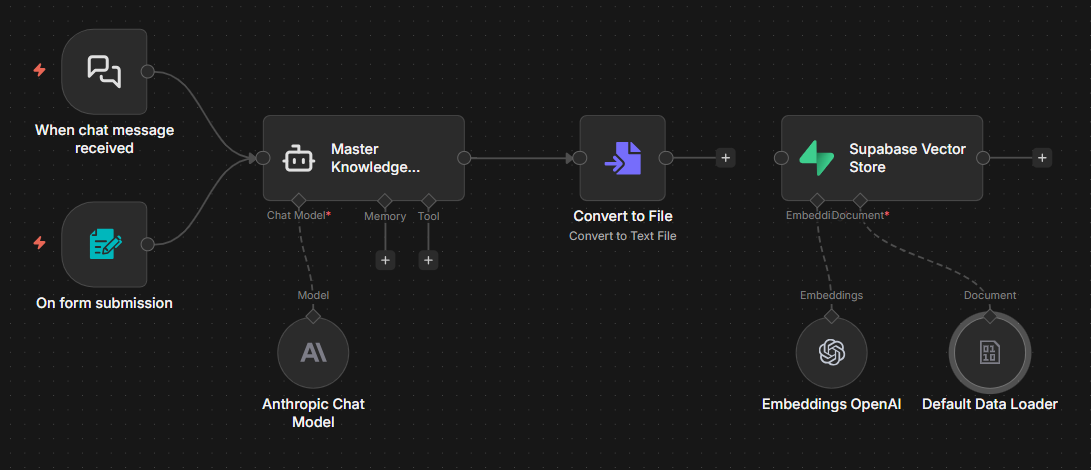
The architecture includes:
How it works in practice
You feed the knowledge base
Upload your documents (FAQs, product guides, HR policies, etc.). The system chunks them and indexes them for search.
A user asks a question
“What's your return policy?”
The assistant searches your documents
It retrieves relevant passages in your documentation about returns.
It formulates a natural response
Using the retrieved documents, the assistant generates a clear, conversational answer.
It responds with voice
The response arrives in 200–400 milliseconds.
Use cases that drive ROI
Why this matters for SMBs and startups
Controlled costs
The assistant supports routine questions and helps the team reserve time for cases that need personal judgment.
Capacity planning
Capacity, latency, and response quality need testing against the expected volume of conversations.
A shared source of information
A maintained knowledge base provides a consistent reference; answers still need appropriate evaluation.
Modern experience
Your customers and employees get a smooth voice experience that matches the personal assistants they use every day.
The numbers that matter
End-to-end response time
Reaction time when users interrupt
Designed for ongoing availability, subject to service operation
Responses are instructed to use official documentation
Ready to transform how people access your knowledge?
This technology isn't just for enterprise anymore. With the right tools and a well-designed architecture, any SMB or startup can deploy an intelligent, secure voice assistant.